What we offer isn't a list of services. It's a connected system of care.
G.L.O.M. TAY delivers clinical, psychiatric, crisis residential, and life transition services across a four-tier continuum — coordinated under one provider so that youth and young adults never have to start over as their needs change.
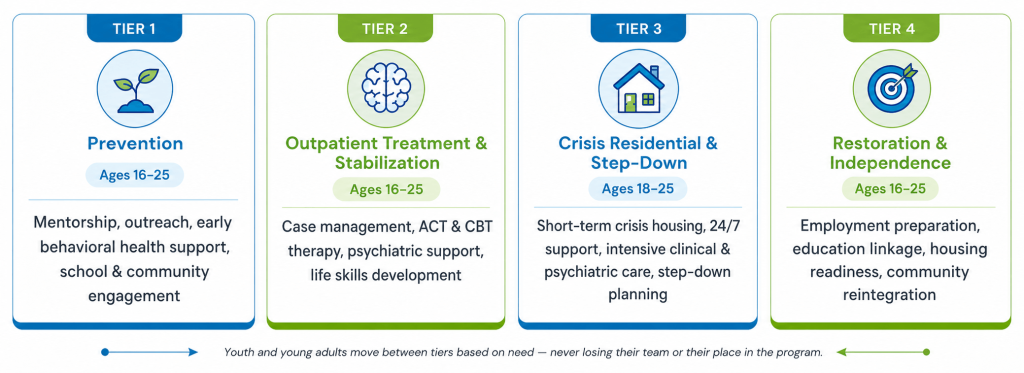
4-Tier Continuum of Care
Our continuum is designed so that youth and young adults never have to start over as their needs change. Movement between tiers is based on clinical need — not age, time limits, or system availability.
Clinical Services
Our licensed clinical staff deliver non-medical services grounded in evidence-based practice. Our clinical team draws on ACT and CBT frameworks alongside other trauma-informed, culturally responsive, and client-centered therapeutic approaches — tailored to each young person’s individual history, needs, and goals.
- Individual therapy
- Group therapy
- Trauma-informed treatment
- Anxiety & depression support
- Substance use counseling
- Crisis stabilization
- Medication coordination and monitoring
Psychiatric Services
Our psychiatric team provides comprehensive evaluation and ongoing medication management for youth and young adults whose behavioral health needs require a higher level of clinical oversight. Psychiatric services are integrated directly into the care team — not referred out — so treatment stays coordinated and consistent across the entire continuum.
- Psychiatric evaluation & diagnosis
- Medication management & monitoring
- Coordination with clinical and case management teams
- Crisis psychiatric support
- Consultation for co-occurring disorders
- Telehealth psychiatric appointments available
Integrated, Not Referred Out
Residential Services
Residential services are available exclusively as part of Tier 3 — Crisis Residential & Step-Down — for eligible youth and young adults ages 18–25 who require a structured, supervised living environment as part of their stabilization plan.
This is not a general housing program. Residential placement is based on clinical need, assessment, and availability — and is coordinated directly with the individual’s clinical and case management team to ensure continuity of care throughout their stay and into the step-down process.
- Short-term crisis stabilization housing
- 24/7 on-site support and supervision
- Daily structure and clinical programming
- Step-down planning toward independent living
- Coordination with clinical and case management teams throughout placement
Case Management
Our case managers serve as the connective tissue of the continuum — coordinating care, navigating systems, and making sure every young person has access to the resources they need, when they need them.
- Comprehensive intake assessment
- Individualized treatment planning
- Benefits navigation (Medi-Cal, SSI, housing subsidies)
- System linkages and warm referrals
- Court and probation coordination
- Ongoing monitoring and care coordination
- 24/7 crisis support access
What Makes Our Case Management Distinctive
Education & Vocational Training
Education and vocational support is one of the most critical — and most underserved — needs for TAY youth. Many of the young people we serve have experienced interrupted schooling, limited work history, and few connections to career pathways. G.L.O.M. TAY provides structured, individualized support to help youth and young adults identify their goals and build the skills, credentials, and connections to reach them.
Job Readiness & Employment Support
- Resume building and interview preparation
- Job placement and employer connections
- Workplace readiness and professional skills development
- Ongoing employment coaching and retention support
- Benefits counseling related to employment transitions
Education & Training Pathways
- School re-engagement support and planning
- College enrollment guidance and navigation
- Vocational and trade program linkages
- GED and alternative education pathways
- Financial aid and scholarship navigation
- Ongoing academic support and accountability
Understanding the TAY population we serve.
of TAY have a mental health diagnosis

youth aging out of foster care develop substance dependence
of young men who age out are convicted of a crime
of foster youth want to go to college — and need support to get there

girls who age out become pregnant before age 21
of the homeless population on any given day are youth ages 18–24